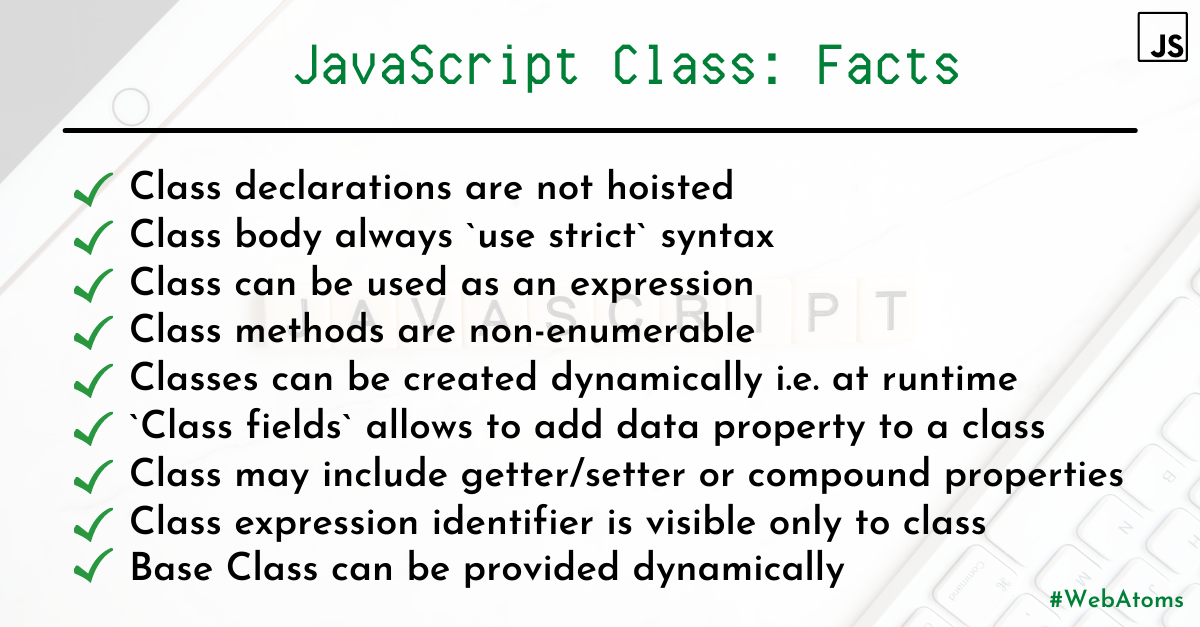
Classes
Classes are template for creating objects. They are "special functions" and have two components:
- Class Expression
- Class Declaration
Let's learn about some facts related to a Class.
1. Class declarations are not hoisted
Function declarations are hoisted but class declarations are not. The class has to be declared first and accessed later, otherwise will throw a Reference Error.
var shape = new Shape(); //Reference Error

class Shape{}
2. Class body always 'use strict' syntax
All the code written in a class construct is subject to strict mode syntax for increased performance.
3. Class can be used as an expression
Class expressions may or may not have a binding identifier. They allow you to redfine classes without errors. The typeof classes generated using class expression always returns function. The classes can be defined inside another expression, passed, returned or assigned; when used as a class expression.
4. Class methods are non-enumerable
Once you define a class, the enumerable flag is set to false for all methods in the prototype. This helps when we execute for...in over an object, class methods are usually not needed.
5. Classes can be created dynamically i.e. at runtime
function webAtoms(input) {
return class {
greet() {
console.log("Hello " + input);
}
};
}

var message = webAtoms("WebAtoms"); //Create a new class
new message().greet(); //Hello WebAtoms
6. 'Class fields' allows to add data property to a class
Class fields synatx allows to add any data property to a class. The property created using class fields is not set on on class prototype, but on the individual object.
class Software{
name = "WebAtoms";
type = "FrameWork"
}

var software = new Software();
console.log("Hello " + software.name + " " + software.type); //Hello WebAtoms Framework
console.log("Software Prototype: ", Software.prototype.name) //undefined
Output
Hello WebAtoms FrameWork
Software Prototype:  undefined
We can also use complex expression and function calls for a class field.
7. Class may include getter/setter or compound properties
The syntax is similar to object literals.
class GetSetDemo {
get data() {
return "I am getter property";
}
set data(message) {
console.log(message + " I am a setter property")
}

}

var getSetDemo = new GetSetDemo();
getSetDemo.data = "Hi,";
console.log(getSetDemo.data);
Output
Hi, I am a setter property
I am getter property
8. Class expression identifier is visible only to class
The identifier i.e. name with which a class expression is identified is visible within the expression only. You cannot access it from the outside.
const Demo = class Test{
getIdentifier() {
return Test.name;
}
};

var instance = new Demo();
console.log(instance.getIdentifier()); //Test
console.log(Test.name); //Reference Error
Output
Test
Uncaught ReferenceError: Test is not defined
9. Base Class can be provided dynamically
Like, you can create classes at run-time; base class can also be provided at run-time.
Final Notes
evalorargumentsare reserved keywords and cannot be used asclassnamesconstructorname cannot be used for a generator method or getter/setter methodprototypemethods cannot be used as constructor; results inTypeError
 |  |  |  |
| Like | Comment | Save | Share |
/api/attachments/att/4/linkedin-null-nan-1200-628.png/linkedin-null-nan-1200-628.100.jpg)
/api/attachments/att/249/webP.gif/webP.100.jpg)